How-to guides
Reading your ESR before resubmitting
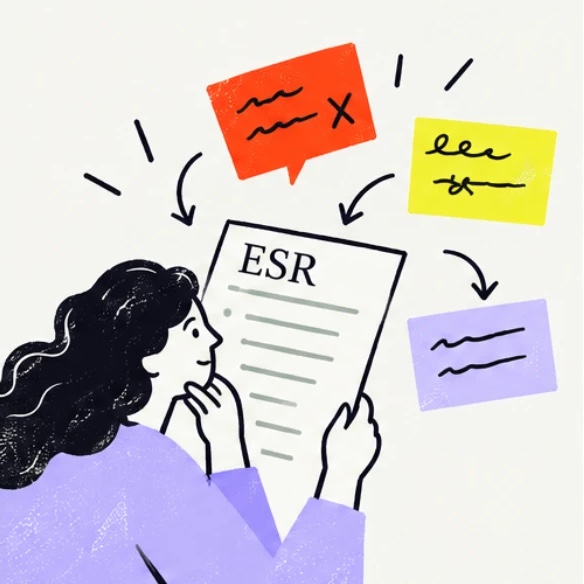
The Evaluation Summary Report (ESR) is the document that tells you how the experts scored your Horizon Europe proposal and why. It lists shortcomings and does not tell you how to fix them, so before resubmitting you have to turn its comments into your own revision list. The rules below come from the 2026-2027 work programme documents.
What the ESR contains
The ESR arrives with the evaluation result letter and is stored with the proposal's documents in the Portal (Online Manual). It is built on the consensus report, the text agreed by the experts who read your proposal. The Commission's briefing for experts (version 14.0, April 2026) says the two are identical in most cases.
For a Research and Innovation Action or Innovation Action, the evaluation form (version 4.0, November 2025) has three blocks: Excellence, Impact, and Quality and efficiency of the implementation. Each block has a comment and a score from 0 to 5, and half marks are allowed. The score is given for the criterion as a whole, not for each aspect listed under it.
| Score | Label | What the wording signals |
|---|---|---|
| 5 | Excellent | Any shortcomings are minor |
| 4 | Very good | A small number of shortcomings |
| 3 | Good | A number of shortcomings |
| 2 | Fair | Significant weaknesses |
| 1 | Poor | Serious inherent weaknesses |
| 0 | No label | Criterion not addressed or cannot be assessed |
For full proposals the threshold is 3 for each criterion and 10 for the total of 15. For Innovation Actions the Impact score is weighted by 1.5, but only to set the ranking. Topics can set different thresholds.
The briefing also tells experts how to write comments: explain shortcomings without recommendations, make no comparison with other proposals, do not count one weakness under two criteria, and match the comment to the score.
Evaluation review (redress)
If you believe the procedure was flawed, the coordinator can ask for an evaluation review. Under Annex F of the General Annexes 2026-2027:
- only procedural aspects can be reviewed, not the experts' judgement of the proposal's merits;
- the request must reach the granting authority within 30 days after you access the results, and a notification not opened within 10 days of sending counts as accessed;
- the request is limited to 7 000 characters;
- a review committee either confirms the evaluation or recommends a re-evaluation, done mainly by experts who did not see the proposal before.
The Online Manual adds that only one request per proposal is considered, that disagreeing with the experts' reasoning is not a ground, that a re-evaluation uses the proposal as originally submitted, and that the new score can be lower.
What the rules say about resubmission
The General Annexes 2026-2027 set no general limit on sending a rejected proposal to a later call. Calls of the European Research Council and the European Innovation Council follow separate work programmes.
Part A of the application form (version 5.1, January 2026) asks whether the proposal, or a very similar one, was submitted to any EU programme in the past 2 years, and asks for its reference number. The briefing tells experts that for such declared resubmissions, comments and scores that differ significantly from the previous ESR should be specifically justified, if the two proposals were written under comparable conditions.
Criteria also change. The briefing notes that from the 2026-2027 work programme the Impact criterion no longer covers the scale and significance of the project's contributions, so an older ESR comment on that point has no matching aspect now.
Turning the ESR into a revision list
- Split every comment into single statements, one strength or shortcoming per line.
- Label each line with its criterion and the aspect it belongs to, using the award criteria table in Annex D.
- Mark the weight of each shortcoming with the score wording: minor, shortcoming, significant weakness.
- Next to each line, write the section and page of the old proposal it refers to.
- Decide the action for each line: add missing content, make existing content easier to find, or change the design.
- Check each line against the new topic text and the current criteria, and delete lines that no longer apply.
- Keep the strengths in a separate list, so the revision does not remove them.
Sources
- Horizon Europe Work Programme 2026-2027, 15. General Annexes
- Evaluation form (HE RIA and IA), version 4.0, 12.11.2025
- Horizon Europe proposal evaluation, Standard Briefing, version 14.0, 15.04.2026
- Standard application form (HE RIA and IA), version 5.1, 22.01.2026
- Online Manual: Evaluation and evaluation results
- Online Manual: Complaints about proposal rejection